
FAQ's - Frequently Asked Questions
General Questions
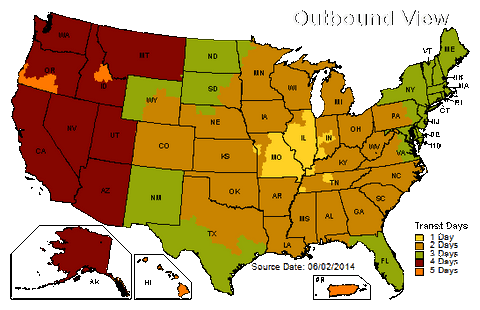
- How long will it take my IQ to arrive?

General IQ Questions
- - Why doesn't my IQ match my pit's thermometer ?
-
IQ probes are super accurate when they leave the factory (0.2% of full scale), but can become inaccurate with exposure to moisture, extreme temperature, and mishandling. If you keep your probe out of the dishwasher, don’t subject it to temperatures over 500 degrees, and don’t pinch the cable under the lid, it will retain its accuracy.
More often than not, what customers are seeing is the normal temperature variations or gradients that occur in BBQ pits. It is not uncommon for a thermometer on the lid to read 25 degrees or more different then the temperature at the cooking grate.
For a more in depth answer explanation click here! - - Why doesn't my fan blow when it should?
-
Intuitively, the fan should always spin when the pit temp is below the setpoint, or always stop when above the setpoint, right? Well, in this case intuition is wrong. Let's extend the logic to a helicopter trying to land; the helicopter needs to be on the ground, yet it is 100 feet above the ground so the rotor should stop spinning, right? Ok, enough silliness.
The fan control algorithm is not a simple on/off one. The fan's speed and on/off duty cycle are computed by a complex hybrid heuristic/PID control algorithm. During startup, the fan may not spin at all if the temperature rate-of-rise satisfies the algorithm. Or, when near the setpoint, it may appear sporadic as it tries to settle in without overshooting. Or, when the setpoint is suddenly increased, it may again appear sluggish and sporadic as it tries to slowly adjust the fire's temperature. But, if you wait a few minutes it will probably be behaving as you think it should, and frequently stable in temperature in 15-20 minutes. - - I've been cooking my turkey at 250 ̊ for several hours now, but it's almost time to eat, so I set my IQ to 350 ̊ to finish the cooking faster, but it has trouble achieving this temperature. Is there something wrong with it?
-
Probably not. You and your IQ built a nice 250 ̊ fire that has lasted hours. By now, most if not all of the charcoal has been started and in fact probably most has burned away. When you set your IQ to 350 ̊, it starts adding air as if it is feeding a fresh fire, when in reality it is feeding a soon-to-be dead fire. If you repeat this test, but set your IQ to 350 early on, you would see the IQ's ability to get some fresh charcoal burning and raise the temperature. The best thing to do in this situation is add fresh charcoal that has been started in a charcoal chimney.
- - My IQ is set 100 ̊ higher than the current pit temperature but the blower is not turning. The blower is obviously bad, right?
-
Probably not. The temperature control algorithm in the IQ is the result of years of development and testing and more than a thousand cooks (many at KCBS competitions). The IQ is able to increase temperature by igniting fresh charcoal, but it struggles to reduce temperature. For this reason, it tries to achieve temperature slowly without overshooting the target. If the temperature in the cooker is climbing at least 10 ̊ per minute without the IQs help, as is often the case during startup, the IQ will not assist the process, but will wait until the temperature climb slows down and then it will start blowing. Most of the time, if you walk away from your IQ for 15-20 minutes, it will be cooking where you want it when you get back!
- - How can I test my IQ at home? (The Oven Test)
- You can test your IQ at home using your oven. Note that most ovens hold a fairly accurate average temp, but can cycle above and below it quite a bit.
1) Starting with a cold oven, or being very careful with a hot oven, clip your pit probe's alligator clip to a the middle of a rack in the middle of the oven.
2) Set your IQ on a kitchen counter or floor away from the oven. Plug the probe in to the IQ and gently close the oven door on the probe's cable.
3) Turn your oven on and set it to 250°F. Wait for your oven to get to temperature and stabilize.
4) Turn on your IQ and set it to 250°F. Wait a few minutes and you should see that your IQ is reading at or near 250°F.
5) If it is a few degrees off, then it is likely that your IQ is reporting the temperature error of your oven. (The IQ's RTD probe is more accurate then your kitchen oven's thermocouple). If it is way off, then you may have a probe issue. If your probe's cable has been pinched, overheated, or subjected to moisture, you should buy a new probe.
- - Will the IQ's work on Gateway Drum Smokers & RipTangle Smokers?
- Absolutely! The IQ's nail Gateway Drum Smokers, RipTangles, and other Ugly Drum Smokers with intake riser tubes that are at least 1.7" ID. We sell a hose flange adapter that slides over the IQ's hose, the hose drops in the intake riser tube, and the flange adapter sits on top the riser tube flange. "pitmasterIQ BBQ" runs their IQs at 300˚F for all four meats on Gateway Drum Smokers and Riptangles.
- - What is the temperature range of the Nylon Hose Barb Adapter?
-
The formal temperature range is -50˚F to 275˚F. As stated by the manufacturer, it is "high service temperature, high impact resistance and tensile strength with automotive industry approvals ". Under normal conditions, the hose barb is a few inches from the pit and has cool air blowing through it, never getting anywhere near 275˚F.
Black nylon is also commonly used in plastic cooking utensils - you probably use one to flip your fried eggs and burgers. When used properly the nylon hose barb is the best choice for connecting your IQ to your pit, because if there is a problem, it will act as a thermal fuse allowing the IQ's hose to automatically release from the pit.
Then why did my hose barb melt? Well, you let it get too hot. You may be upset that you have to replace the nylon hose barb, but if you would have been using our competitor's product, you would be replacing an $80 blower instead. This is why the IQ is designed with the blower in the enclosure, away from the pit.
So how do I keep from overheating my hose barb? Only leave your adapter on the pit when you are carefully controlling the fire and smoking meat. If you take your lid off and walk away from the pit, the fire temperature will rise uncontrollably and likely overheat both your adapter and your probe.
When using a Weber Smokey Mountain, use your smoker's fire ring to contain the briquettes. If you let the hot briquettes touch the wall of the smoker where the adapter is attached, you run the risk of overheating the adapter. Same goes with any other smoker - keep the hot embers from touching the cooker's wall where the adapter is attached - leave an air space there.
If you're searing steaks on your Weber Kettle, first remove your adapter. If you prefer to leave your adapter on your pit when not in use, at least cap it with the included silicone cap. This will prevent hot air from the fire from passing through the adapter.
Finally, we offer an aluminum hose barb for customers that have a special application and simply demand it!
- - How does the IQ control the temperature of a charcoal cooker?
- The cooking temperature is measured by the alligator clip on the temperature probe. This temperature is adjusted to match the temperature set on the dial by increasing or decreasing the amount of air blown into the cooker.
- - Can I hang the IQ from my pit?
- Only if you are running the pit at 250°F or lower, and the IQ's enclosure is at least 1" away from the pit, and the fire is not built directly behind the IQ's enclosure. If on a kettle, the fire must be built for indirect cooking in the REAR of the pit. If the metal behind the IQ's enclosure is too hot to touch for 1 second, then it is too hot to hang the IQ there. Instead, set it on the ground or a small table. Overheating the enclosure will void the warranty.
- - Is the IQ temperature resistant?
- Yes, when used according to instructions, the IQ will not be damaged. If the IQ is on a pit and the temperature ramps up very high, due to a grease fire or improperly starting the pit, the IQ may be damaged. In this case, the warranty will be void.
- - What are the IQ's power requirements?
- The IQ requires 12VDC at 1A. The jack is 5.5mm OD, 2.1mm pin, and center positive. A 120VAC to 12VDC power supply is provided. A 12VDC cigarette lighter cable is available from our store for powering with a car or a "jumper box". We sell replacement power supplies, however they are also available at Radio Shack. Ask for the 12v 1.5A Enercell Adapter ($30) p/n: 273-358. Requires Adaptaplug "M" p/n: 273-344 at no additional charge (it's included, don't let them charge you)
- - Can the IQ110 be operated in the rain?
- The IQ110 must be kept dry at all times. Subjecting it to water may void your warranty. It is dangerous to use 120VAC appliances in wet conditions, and may lead to fatal shock. If it must be operated in wet conditions, it must be covered so that water cannot get in it, yet the blower intake must be able to breath, and it must be powered with a 12VDC battery.
- - Will the IQ work with my Big Green Egg or other ceramic cooker?
- Absolutely! We offer four adapters designed to fit into the lower draft door of kamado style cookers and Backwoods Smokers.
1. The most universal is the Large Kamado Adjustable Adapter Kit. The large adjustable kamado adapter has sliding clip to fit most Big Green Egg style kamado cookers including Big Green Egg XL, Large, and Medium, all Primo Kamado sizes, all Big Steel Kegs, all Bubba Kegs, Costco's (Phase II) Vision and Kamado Joes Big and Classic. Adapter plate rotates and adjustment clip moves to accommodate door heights from 2-3/4" to 3-3/4". Includes stainless steel adapter plate, stainless steel adjustment clip, reusable hose clamp and kill plug.
2. The Small Adjustable Kamado Adapter has sliding clip to fit most small Big Green Egg style kamado cookers including Big Green Egg Small, Chargriller Acorn and Grill Dome. Adapter plate rotates and adjustment clip moves to accommodate door heights from 1-5/8" to 2-3/8". Includes stainless steel adapter plate, stainless steel adjustment clip, reusable hose clamp and kill plug.
3. The Fixed Size Kamado Adapter Kit has a 3-9/16" x 2" x 1/16" aluminum pit adapter plate. Designed to fit the Big Green Egg XL and Big Steel Keg. Can be easily cut to size with hacksaw. Slides in vent door rail from the side. Includes hose clamp and kill plug.
4. Medium Adjustable/Backwoods Adapter Kit - has sliding clip to fit most Backwoods Smokers with a sliding draft door. Adapter plate rotates and adjustment clip moves to accommodate door heights from 2-1/8" to 3-1/8". Includes stainless steel adapter plate, stainless steel adjustment clip, reusable hose clamp and kill plug. - - Will the IQ work on other cookers?
- Probably. The temperature probe cable is 72" long. This must be long enough to reach the desired cooking temperature regulation area. However, the 15 CFM air blower is powerful enough for almost all cookers. It has been tested on many pits from 25 lb. Weber Kettles to 600 lb. Superiors (Stumps clone).
- - How should I set my vents?
- The IQ works by adding air, or not adding air to the fire. Your vents should be set so that when additional air is not being blown into the fire, it will eventually go out. This will allow the IQ to lower the temperature by not blowing air, and to increase it by blowing air. If your pit is leaky, you should probably run with all vents closed. If it is tight, you might want to run with the top vent open 1/8", but in all cases always run with the bottom vents closed off. If you can't tightly close off the bottom vents, cover them with high temperature aluminum tape.
- - How do I start up a Big Green Egg, Primo Kamado, Big Steel Keg, Bubba Keg or other egg style cooker with the IQ110?
- 1) Do not power the IQ or connect the temperature probe until instructed to do so.
2) Inspect the fit of the IQ adapter to make sure there are no major air leaks around it. Make sure your lower vent door is closed and butted up against the air adapter.
3) Inspect the fit of your lid against the body of the cooker to make sure there are no major air leaks.
4) Free your top vent so that it turns freely.
5) Remove your cooking grate.
6) Make sure your firebox is clean and free of all ashes and old charcoal.
7) Position your IQ, get your extension cable or power source ready and connect the air tube to the adapter but don’t power up the IQ yet!
8) Place a 1/2 load of dry charcoal in the firebox.
9) Make a small hole in the center of the charcoal load from the top, about 2” deep.
10) Place a lighter cube in the hole and light. Let the cube burn, with the lid open, until it burns out all the way, about 5-10 minutes.
11) Place your smoke wood in the fire box.
12) Place your cooking grate and diffuser, if using one.
13) Attach the temperature probe to the cooking grate ONLY IF THE FIRE IS SMALL AND THERE IS NO THREAT OF THE FLAME GETTING WITHIN 6” OF THE PROBE/CABLE.
14) IMMEDIATLY after attaching the temperature probe, close the lid.
15) Set the top vent to about 1/8” open. Try the thickness of a nickel.
16) Apply power to the IQ and set the desired cooking temperature.
17) Wait until the IQ is stable in the green region, 10-20 minutes, then add food to be cooked.
Tips:
1) Don't try to understand the IQ’s blowing pattern. It is complicated and it will drive you nuts.
2) Don't worry if the IQ enters the red (warm) zone or flashing green (cool) zone during startup – it can be as few as 10 degrees off at this point and if you have built the fire correctly, the IQ will recover.
3) If you are struggling with the learning curve, try using Kingsford Competition briquettes – they burn much more predictably than lump and are all natural like lump is.
4) Moving air is at a lower pressure than static air. Strong winds blowing over the top of the cooker will create a low pressure that will suck air through the cooker and the IQ. You may have to close the top vent a tad more, but not all the way as this will snuff the fire out.
5) Some users have found the blower in the IQ overpowers their highly insulated efficient cookers. Try covering 1/2 or even 3/4 of the blower inlet “pie slices” with clear tape to reduce the blower’s air flow and leakage path.
6) Feel free to experiment and find a method that suits you and your cooker!
- - Will the IQ work with the Weber One-Touch Gold or the Weber Performer?
- Yes! There are two ways to accomplish this. The first method is to remove the ash catcher hardware and simply attach the Standard Manifold and hi-temp tape strips to the kettle as shown in the installation video. The ash catcher hardware removes without tools. In the second method the ash catcher hardware is left on and a 1/2" conduit hole (7/8" hole saw) is drilled in the kettle down low and near the front using the Standard Manifold's 1/4" mounting hole as a hole location guide. Remember to keep the air injection point well below the level of the charcoal grate. The Standard Manifold toggle bolt is then placed through the hole. The hi-temp tape is not used in this case as the One-Touch vents are kept closed. When the IQ is not in use, the hose barb can be capped off using the included Kill Plug. Installation pictures can be seen on the "Weber Gold and Performer Installation" page. NOTE: The Performer Kettle has an attachment for a propane bottle. The propane bottle MUST be removed from the kettle and stored in a safe location while modifying the kettle and using the IQ to regulate temperature. The charcoal should be started with a paraffin cube as shown in the usage video.
IQ110 Specific Questions
- - What do the different LED codes mean?
-
LED Color Meaning Flashing Green Probe temperature is more than 10 °F below the set point Solid Green Probe temperature is within 10 °F of the set point Solid Red Probe temperature is more than 10 °F above the set point Flashing Red Probe temperature is more than 50 °F above the set point Alternating Red/Green - A lid-off condition has been detected and the lid-off delay is in effect, or
- The internal temperature of the enclosure has exceeded 140 °F, or
- The temperature probe has failed
- - The IQ110's LED is solid green, but the thermometer on the pit does not agree with the set point. Why not?
- Frankly, almost all factory installed pit thermometers are junk. Even when they are new, they are not very accurate. As they age and are subjected to weather and extreme hot or cold temperatures, they become even less accurate. Finally, they are measuring the temperature of the air just inside the lid. The IQ's thermometer is VERY accurate. The platinum RTD element inside the housing attached to the alligator clip is accurate to 0.2%! The overall accuracy of the IQ is 1%. Additionally, you are measuring the temperature of the cooking grate near the meat, not the air near the lid. If you are accustomed to cooking at a particular reading on your pit's thermometer, simply adjust the IQ's set point to run your pit at the temperature you're used to running it. But know that the IQ's set point is the actual temperature near the meat, not the reading on the pit thermometer!
- - Why does my IQ110 continuously flash the version number upon powering up?
- Your 12VDC source is weak, causing the IQ to reset each time it tries to power the blower.
IQ120 Specific Questions
- -Why does my IQ120 parameter "Food Pit Set" go to 256 when I try to set it to 0?
- This is a known problem. Execute the "Reset Params" function to return it to 0, or set "Food Temp" (the corresponding parameter) to 0 to disable the functionality.
- -Why does my IQ120 power up and display the version number forever?
- Your 12VDC source is weak, causing the IQ to reset each time it tries to power the blower.
Adapter Questions
- - I want to mount the aluminum hose barb to my cooker. What size does the hole need to be and how long are the threads?
- The best way to bore a hole is to use a 1-5/16" hole saw. The threads are just under 1" long, but figure max wall thickness to be 5/8" to save room for the nut. Note it is best to mount a 1" ball valve to your cooker and then screw the hose barb into that; then you have a solid way to close off the port.
- - What size air manifold do I need?
- The standard air manifold fits the Weber Kettle Silver, Weber Smokey Mountain, and most other pits. Weber Kettle Gold models usually needs to have the ash catching hardware removed. See related FAQ on this page.
- - Does the standard air manifold fit other pits?
- Yes. To test, find a cereal bowl with an inside diameter of about 5-3/8". If the cereal bowl completely covers the vent and rests squarely without rocking, then the standard air manifold should work.
- - Can the standard manifold be attached to a top vent?
- ABSOLUTELY NOT! The air injection point MUST be at or below the level of the fire. Attaching the injection manifold above the level of the fire risks hot gasses passing through the IQ and guess how bad for it that is!
- - How can I remove the air manifold from a bullet style cooker when it's hot?
- If you're using the toggle wing nut, you can back the mounting wing bolt out until the toggle wing nut falls into the bottom of the pit and retrieve it after the pit cools. The preferred method is to use the additional hardware included with the IQ110 to mount a stud to the pit. This way, the retaining wing nut is simply removed and the air manifold slipped off.
Probe Questions
- - How can I test my probe for accuracy?
- One way to test the accuracy of your probe is to do a comparison in boiling water. If you take this route be careful not to submerge the opening end of the probe (where the wire enters the housing) in the water. This can cause erroneous temperature readings..
- - Where should I clip the temperature probe?
- For probe routing or mounting, see our routing and mounting kits here. It depends on the type of pit and how the fire is built. For a kettle with an indirect fire in the rear, the best place is on the cooking grate between the meat and the front of the kettle. See the Gallery page for a video showing this. For a bullet style cooker, the best place is in the center of the cooking grate because the heat flows up the sides around the water pan. Put the clip where it is not in the heat flow and where the fire can't radiate directly on it. A neat trick it to place a wood skewer through the meat being cooked and attach the clip to it a couple of inches above the meat.
- - Does the probe cable require any special handling precautions?
- Yes. It must be kept 6" from the fire. Use aluminum foil as spacing or shielding if necessary. Do not pinch the cable between the pit's lid. This will damage the insulation on the wires. Keep the sensor end of the cable dry where the cable exists the sensor housing. It is water resistant, but not water proof. Additionally, dripping meat juices (fat, salty rubs, etc.) on the probe at this point may cause erroneous temperature readings. We recommend purchasing an additional temperature probe as a spare.